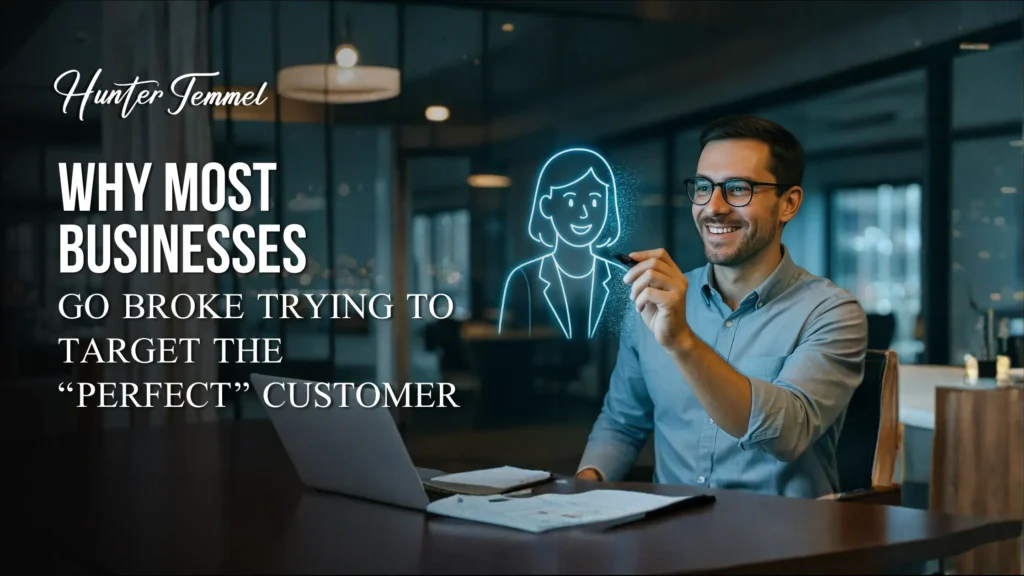
Every entrepreneur swears they know their ideal client. They’ve built a detailed profile: age, income, job title, interests, even favorite coffee order.
But here’s the problem — they’re describing a fantasy, not reality.
Most businesses waste thousands chasing this “perfect” customer — someone too specific, too small in number, or worse, someone who doesn’t actually have intent to buy.
The truth? The goal isn’t to find one perfect person. It’s to find enough of the right people, and then let data show you who’s worth keeping.
The Dangerous Obsession with Precision
Precision feels powerful. It feels like control. But in marketing, too much precision kills scalability.
I’ve seen it countless times: Business owners create 10 layers of filters — age 27–35, female, single, six-figure income, certain job titles, three interests, one zip code — and end up with an audience smaller than a local Facebook group.
Then they wonder why their ads don’t perform.
“You can’t sell to people who don’t exist in large enough numbers.”
Marketing isn’t sniping — it’s pattern discovery. Your job isn’t to perfectly predict who will buy. It’s to launch, learn, and let data reveal where the real demand lives.
How Over-Targeting Destroys Your Data
When your audience is too tight, your algorithm can’t breathe.
Ad platforms like Meta and Google need variety — they learn by testing and optimizing across thousands of impressions. If your targeting is too restrictive, the system never gets a chance to learn who actually converts.
Think of it like teaching a student who only ever sees one question — they can’t grow because they never see enough examples.
Here’s a real case:
I had a client spend $2,000 targeting “pilots over 35 in Colorado.” They got zero leads. We opened it up to “aviation enthusiasts nationwide” — 47 qualified leads in 7 days.
That’s not luck. That’s oxygen for the algorithm.
Over-targeting suffocates your data. Broad targeting lets it breathe, learn, and scale.
The Psychology Behind It: Control vs. Curiosity
The reason most entrepreneurs over-target isn’t strategy — it’s psychology.
They crave control. They want to feel like they’re hand-picking their ideal customers.
But control kills curiosity — and curiosity is what leads to breakthroughs.
“Your ego wants to be right; your data wants to be real.”
Real marketing isn’t about being right — it’s about learning faster than your competition. Let the market surprise you. Sometimes your best customers aren’t who you expected — and that’s the beauty of it.
The Smart Way to Build a Scalable Audience
Here’s how to scale the smart way — the Hunter Temmel Blueprint for audience discovery:
Step 1: Start Broad. Give the algorithm room to test. Use wide interest categories or simple geography-based targeting. Let the system find signals for you.
Step 2: Collect Data. Use lead forms, quizzes, and tracking pixels to identify who’s actually engaging. Let every click, scroll, and form fill teach you something.
Step 3: Narrow Intelligently. Once data rolls in, refine based on behavior, not bias. Double down on what converts — not what you assumed would.
In every campaign I’ve scaled, the best-performing audience was never the one we started with. It was the one the data revealed after testing.
Section 5 — The Data-Driven Mindset Shift
Here’s the shift that separates amateurs from pros:
Stop trying to “target” people. Start trying to attract them.
Go broad → test → analyze → double down.
Let the market tell you who your true buyers are.
“Your job isn’t to find customers — it’s to make it impossible for them not to find you.”
When you think like a data scientist, not a dreamer, your marketing stops being a guessing game and starts being a growth engine.
Final Thoughts: Broaden First, Refine Later
The more you try to control your audience from the start, the more you limit your ability to grow. Start broad, stay curious, and let data do the talking.
The best marketers aren’t fortune tellers — they’re explorers.
——–
If you’re ready to stop guessing and start scaling, subscribe to the newsletter or book a 1:1 lead strategy session with me at huntertemmel.com.